
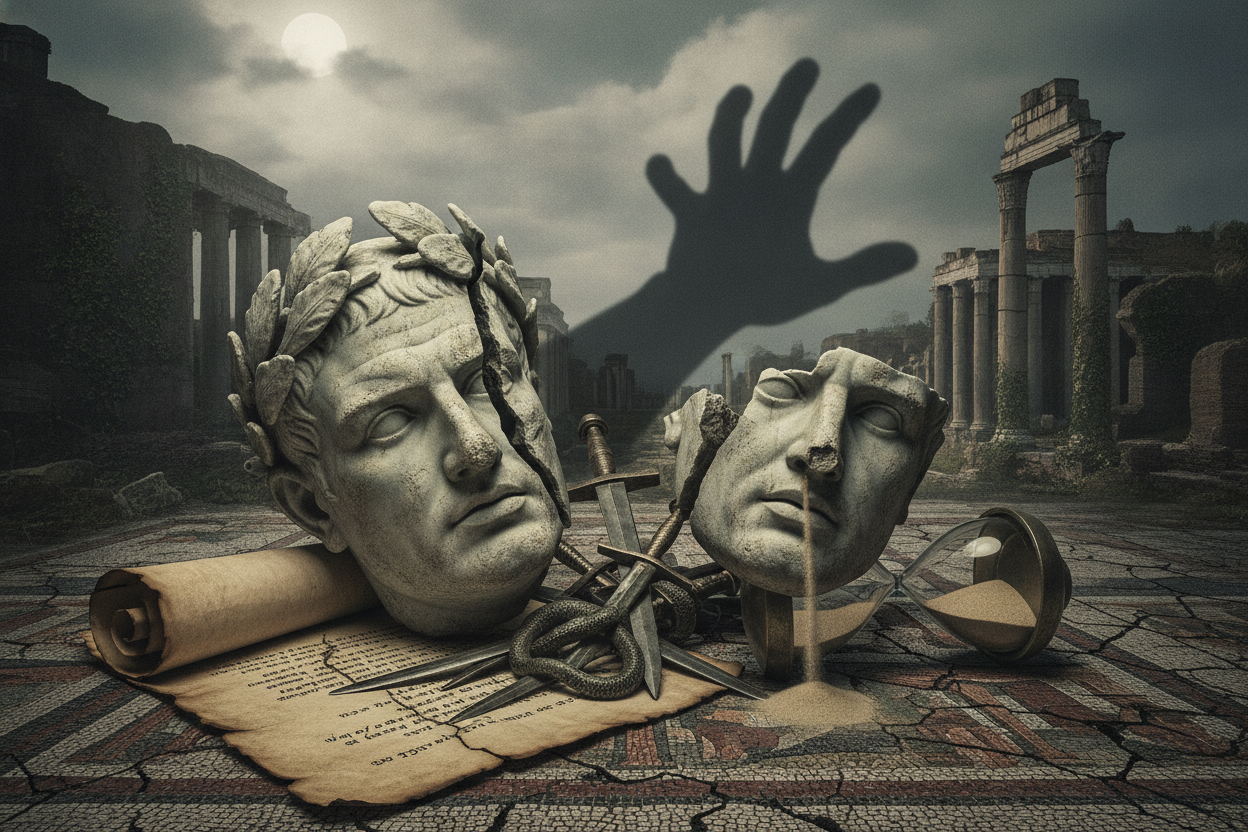
Julius Caesar is often read as a political tragedy, but it also offers a rich study in nihilism because it reveals how fragile public meaning becomes when speech is detached from conviction. The play’s senators, conspirators, and orators all compete to define reality, yet each version of events appears unstable. What seems certain in one scene becomes rhetorical manipulation in the next.
The assassination itself does not restore order; it multiplies uncertainty. Brutus acts in the name of principle, but the principle quickly proves vulnerable to interpretation. Antony’s funeral speech then demonstrates how language can manufacture political truth from grief, resentment, and performance. That instability makes the play an important counterpart to Hamlet, where speech also fails to secure a stable moral center. In both works, words are powerful precisely because they are unreliable.
Shakespeare’s treatment of omens, dreams, and public rumor further deepens the atmosphere of existential doubt. The world of the play seems haunted by signs that cannot be read with confidence. This connects Julius Caesar to Macbeth, where prophecy also disturbs moral agency, and to Troilus and Cressida, where public ideals collapse into cynicism. Political life, Shakespeare suggests, may be built on forms that conceal emptiness rather than resist it.
For a series devoted to nihilism in Shakespeare, Julius Caesar offers an especially useful angle because it shows how collective language breaks down under pressure. Patriotism, loyalty, and honor all become contested terms. The result is a drama in which power survives, but meaning does not. That is a bleak insight, and one Shakespeare returns to again and again in different registers.
Leave a Reply