
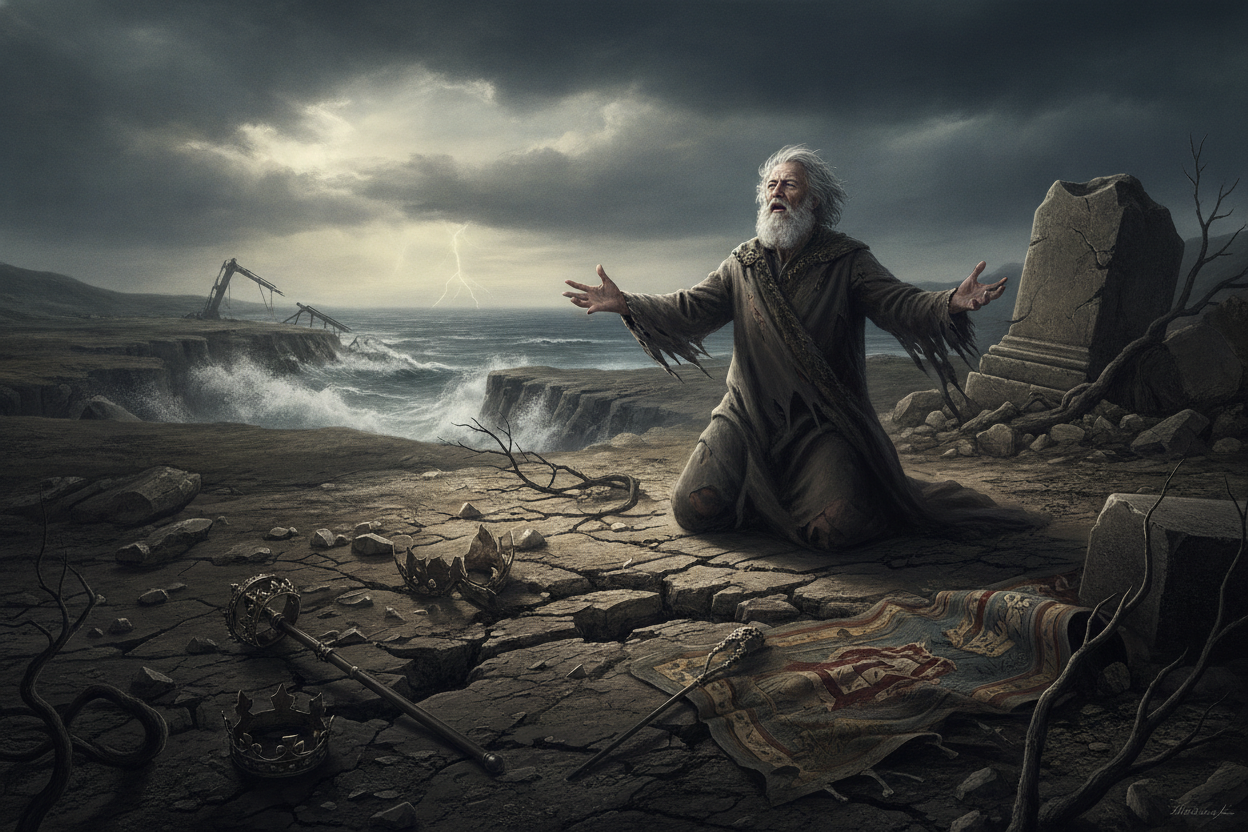
King Lear is one of Shakespeare’s most devastating examinations of meaninglessness because it tears away the social and emotional structures that usually stabilize identity. The division of the kingdom begins as a political act, but it quickly becomes an experiment in nihilistic exposure. Once Lear misreads flattery as truth, the play drives him into a world where authority no longer guarantees wisdom and love no longer secures loyalty.
The storm scenes are crucial to any serious reading of the play’s philosophical darkness. Lear’s confrontation with the elements is not simply meteorological spectacle; it is an encounter with a universe that seems indifferent to human suffering. Like Hamlet, Lear discovers that language cannot restore order, but unlike Hamlet, he experiences this discovery as collapse rather than suspension. The result is a world in which moral justice appears absent or grotesquely delayed.
Shakespeare intensifies this sense of void through the parallel plot of Gloucester, whose blindness literalizes the failure to see truth before it is too late. The play’s recurring reversals make it useful to compare with Macbeth, where ambition corrodes moral structure from within, and with Timon of Athens, where generosity curdles into absolute mistrust. In Lear, however, nihilism is not merely psychological; it becomes cosmic.
Even so, the play does not end in simple negation. Its bleakness forces readers to ask whether compassion can emerge only after illusion is destroyed. That question links Lear to other Shakespearean tragedies in which suffering strips away ceremony and leaves the bare fact of human vulnerability. In that sense, King Lear is not only about the loss of meaning but about the terrifying clarity that follows it.
Leave a Reply