
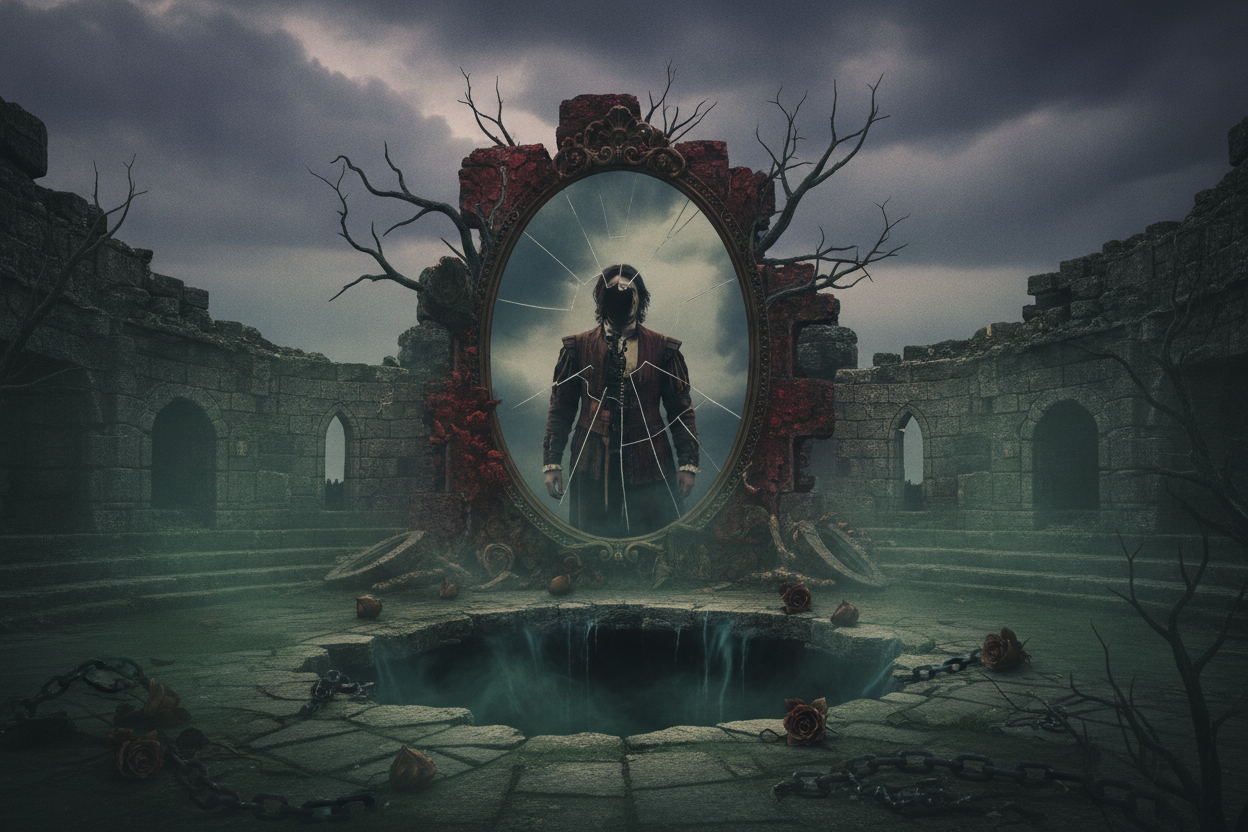
Across Shakespeare’s tragedies, broken worlds recur with remarkable consistency. States fail, families fracture, lovers mistrust each other, and speech itself becomes unreliable. These repeated patterns matter because they suggest that nihilism in Shakespeare is not confined to a single play or character. It is a structural possibility embedded in the dramatic imagination.
Hamlet, King Lear, Macbeth, and Troilus and Cressida each produce a different version of collapse, yet they share a common logic. In each, the forms meant to secure meaning begin to betray it. Kingship becomes vanity, loyalty becomes performance, justice becomes delay, and love becomes unstable or false. Shakespeare keeps returning to the moment when a character realizes that the world’s moral language no longer matches lived reality.
This is why cross-reading matters so much for the site’s essays. A speech in Hamlet can illuminate a curse in Lear; a vision in Macbeth can sharpen a political speech in Julius Caesar; a satirical line in Troilus and Cressida can clarify the bitter social disillusionment of Timon of Athens. The plays do not merely resemble one another. They speak to one another through recurring images of rot, dust, blood, emptiness, and failed judgment.
Yet the value of such comparison is not just thematic. It reveals Shakespeare’s deep interest in how human beings respond to the discovery of void. Some characters seek action, others withdrawal, others mockery, and others grief. That variety is what keeps the plays alive. Shakespeare does not give us one nihilism, but many. The result is a body of work in which despair is never static and meaning never entirely secure.
Leave a Reply